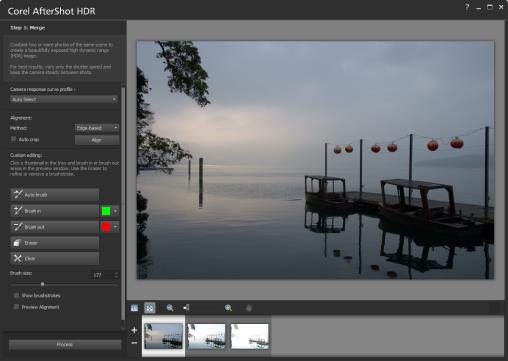
Exposure Merge (Step 1 window)
For more information about taking photos that work well with Exposure Merge, see Taking photos for HDR processing.
Exposure Merge uses a three-step process:
|
|
Merge — Choose your merge settings, and if required, apply custom editing. |
|
|
HDR Adjustments — After merging your photos, you can adjust them and save the results to an editable HDR file before finalizing the merge and fine-tuning. |
|
|
Fine-Tune — Refine your image, with noise-reduction and sharpening options, along with some other familiar tools from the Adjust workspace. When you’re done, you can save to a standard file format and close Exposure Merge. |
Please see the topics below for more detailed information about each step.
|
|
Camera response curve profile — applies a curve adjustment to the image, based on the known characteristics of the sensor in your camera |
|
|
Alignment — Choose between Feature-based (detects features in the photos) or Edge-based (detects edges within the photos). |
|
|
Custom editing — Choose which areas you want to keep (Brush in) or remove (Brush out) from each photo. Often, custom editing is applied to remove "ghosting" — the semitransparent effect caused by merging photos that captured moving objects. |
|
|
Digital Noise Removal is a great tool for cleaning up noise that can result from merging photos. |
|
|
High Pass Sharpen can help reduce blurred areas that may result from movement between photos. |
|
|
Smart Photo Fix and White Balance let you tweak the colors. |
|
|
To brighten the entire image, try adjusting Brightness/Contrast. To brighten only the dark areas, try Fill Light/Clarity. |
|
|
Local Tone Mapping and Fill Light/Clarity can be used to further enhance details in the image. |
|
2 |
Right-click and choose Edit with AfterShot HDR |
|
3 |
In the Step 1: Merge window, choose a profile from the Camera response curve profile drop-list. |
If you are not sure what to choose, select Auto Select.
If the EV interval slider appears, set the exposure value that you used between photos.
|
4 |
In the Alignment area, choose an alignment type from the Method drop-list. |
If you want to crop any edges that don’t overlap, mark the Auto crop check box.
|
5 |
Click Align. |
To see the results, enable the Preview Alignment check box (near the bottom of the panel).
|
6 |
If you want to keep or remove specific areas from individual photos, use the controls in the Custom editing area. See To brush in or brush out artifacts in Exposure Merge. |
|
7 |
Click Process. |
The merge settings are applied and the Step 2: HDR Adjustments window appears.
If you want to tweak your merge settings, click Back to return to the Step 1 window.
You can also add photos to or remove photos from the merge tray by clicking the Add Photos button  or Remove Photos button
  in the tray at the bottom of the Exposure Merge window.
|
|
Click Brush in, and in the preview area, drag over the area that you want to preserve. You don't need to be exact. |
|
|
Click Brush out, and in the preview area, and drag over the area that you want to remove. |
|
|
Click Auto brush if you want the application to auto-detect and remove ghosting. Auto brush works well for removing ghosting along feature edges in photos taken without a tripod. It is not recommended for larger ghost objects, such as cars and people. |
|
Drag the Brush size slider. |
|
|
Click Eraser, and drag across a brushstroke in the preview area. |
|
|
Click Clear. |
|
|
Click the arrow beside the Brush in or Brush out color swatch and click a new color. |
|
|
Mark or unmark the Show brushstrokes check box. |
|
|
Mark the White Balance check box, click Auto or click the Dropper tool |
|
|
Drag the Contrast, Highlights, Midtones, and Shadows sliders to adjust the overall tone and contrast. |
|
|
Drag the Vibrancy slider to saturate or desaturate the colors. |
|
|
From the Detail drop-list, choose Natural detail or Creative detail, and drag the respective sliders to adjust the amount of local detail. |
If you want to focus on black-and-white processing, click the B&W tab below the presets area. To re-enable color processing, click the Color tab.
|
2 |
To save your HDR image for further editing, click Create HDR file, navigate to the folder you want, type a file name, and click Save. |
This saves the image content. You can also save your adjustments as a preset.
|
3 |
Click Process. |
|
Click the Save Preset button |
|
|
Click the Preset Options button |
|
|
Click the thumbnail for the preset, click the Preset Options button, and click Delete. |
|
|
Click the Preset Options button and click Reset. Click Yes in the confirmation dialog box. All custom presets are deleted. |
|
|
Click the arrow |
|
1 |
In the Step 3: Fine-Tune window, apply any of the tools or adjustment options to adjust the final image. |
|
2 |
Click Save and close to save the file, close Exposure Merge, and return to the workspace you were last using. |
When the size of a zoomed-in image exceeds that of the preview area, you can click the Pan tool  and move the rectangle to choose a preview area.
Copyright 2014 Corel Corporation. All rights reserved.


 , and click the image to set the white point. Drag the
  , and type a name in the Save Preset dialog box. A thumbnail is added to the preset area.
 , click
  on the