Quick links to procedures on this page:
• |
• |
Even if you have no experience with digital art, the Auto-Painting panel lets you create paintings based on digital images or scanned photos. You simply choose a Smart Stroke Brush variant and let Smart Stroke Painting and Smart Settings do the work. If you want more control over how the brushstrokes interact with the canvas, you can set individual stroke settings. Although the Smart Stroke Brush variants are optimized for auto-painting, you can also use any Cloner brush variant.
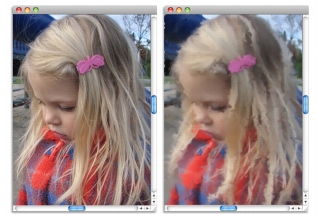
Auto-painting applies brushstrokes to the canvas.
The Auto-Painting panel lets you specify how paint strokes are applied to a photo. You can choose from the following options:
• |
Smart Stroke Painting — automatically applies paint strokes that follow forms in
the photo
|
• |
Smart Settings — changes the size, length, and pressure of brushstrokes in areas of
greater detail. This option can be used with Smart Stroke Painting to preserve
detail from the source photo.
|
• |
Stroke — lets you choose a brushstroke. You can also add custom brushstrokes to
the list.
|
• |
Randomness — introduces an “accidental” quality in color and stroke. Randomness
contributes to the appealing, unique look of artwork created with Corel Painter.
You can control the randomness of the following settings:
|
• |
Pressure — lets you set a value from 0 to 100 to specify the amount of pressure
with which brushstrokes are applied. This setting represents the percentage of
the preset pressure for the Stroke option.
|
• |
Length — lets you set a value from 0 to 100 to specify the length of the
brushstrokes. This setting represents the percentage of the preset length for the
Stroke option.
|
• |
Rotation — lets you set a value from 0 to 360 degrees to specify the rotation of
the brushstrokes.
|
• |
Brush Size — lets you set the brush size
|
You can control the speed of auto-painting so that you can see how and where individual strokes are applied. You can also stop the auto-painting process at any time.
| To auto-paint a photo by using Smart Stroke Painting |  |
1 |
In the document window, select the image that you want to auto-paint.
|
2 |
Choose Window  Auto-Painting Panels Auto-painting. Auto-Painting Panels Auto-painting.
|
3 |
In the Auto-Painting panel, enable the Smart Stroke Painting check box.
|
If you want the paint strokes to adjust automatically in size, length, and pressure to areas of greater detail, enable the Smart Settings check box. |
4 |
In the Auto-Painting panel, adjust the Speed slider to control the speed at which
brushstrokes are applied.
|
5 |
Click the Play button  . .
|
Brushstrokes are applied automatically. You can view the auto-painting progression more easily when Tracing Paper is turned off. If Tracing Paper is turned on, you can turn it off by pressing Command + T (Mac OS) or Ctrl + T (Windows). |
6 |
Click the Stop button  when you are satisfied with the results. when you are satisfied with the results.
|
If you do not click the Stop button, auto-painting stops at the end of the brushstroke cycle. |
| To auto-paint a photo by using Stroke settings | |
1 |
In the document window, select the image that you want to auto-paint.
|
2 |
In the Auto-Painting panel, choose a stroke from the Stroke list box.
|
3 |
Adjust any of the following settings: Randomness, Pressure, Length, Rotation, or
Brush Size.
|
4 |
Adjust the Speed slider to control the speed at which brushstrokes are applied.
|
5 |
Click the Play button .
|
Brushstrokes are applied automatically. |
6 |
Click the Stop button when you are satisfied with the results.
|
If you do not click the Stop button, auto-painting stops at the end of the brushstroke cycle. |
 |
You can use a custom stroke by clicking the menu arrow beside the Stroke list
box and choosing Record Stroke. Paint a stroke on the canvas, and choose
Save Stroke from the same menu. Your stroke is added to the Stroke list box.
For general information about recording brushstrokes, see Recording and
Playing Back Brushstrokes.
|

|
Copyright 2012 Corel Corporation. All rights reserved.
 button, and then adjust the slider.