
Quick links to procedures on this page:
• |
• |
• |
Corel PHOTO-PAINT provides several different ways to improve the appearance of an image that has small dust and scratch marks. You can apply a filter to the entire image, or if an image has one or more scratches in a specific area, you can create a mask around the scratches and apply the filter to the editable areas.
The filter works by eliminating the contrast between pixels that exceed the contrast threshold you set. You can set a radius to determine how many pixels are affected by the changes. The settings you choose depend on the size of the blemish and the area surrounding it. For example, if you have a white scratch that is 1 or 2 pixels wide on a dark background, you can set a radius of 2 or 3 pixels and set the contrast threshold higher than if the same scratch were on a light background.
You can also remove imperfections, such as tears, scratch marks, and wrinkles, from an image by blending its textures and colors. Similar to using a filter, you choose the range of pixels necessary to retouch the image, depending on the size of the correction and the area surrounding it.
If the scratch or blemish is fairly large or in an area of the image that has a varied color and texture, such as leaves on a tree, you can achieve better results by cloning image areas. For information about cloning, see Cloning image areas.
| To remove small dust and scratch marks throughout an image | |
1 |
Click Image  Correction Dust and scratch. Correction Dust and scratch.
|
2 |
Move the following sliders:
|
• |
• |
Threshold — lets you set the amount of noise reduction. Set the threshold as
high as possible to retain image detail.
|

You can remove small dust and scratch marks from an image by applying the Dust and scratch filter.
| To remove scratch marks from part of an image | |
1 |
Define an editable area that includes the scratch marks.
|
2 |
Click Image Correction Dust and scratch.
|
3 |
Move the following sliders:
|
• |
• |
Threshold — lets you set the amount of noise reduction. Set the threshold as
high as possible to retain image detail.
|
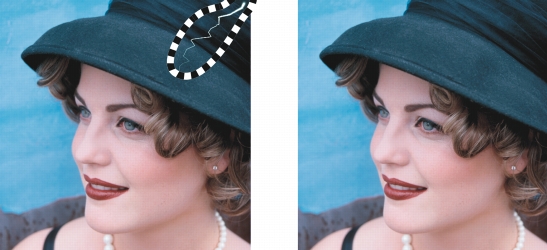
You can remove a scratch from a specific area by surrounding the scratch with a mask before applying the Dust and scratch filter. A dashed line or red-tinted overlay indicates the presence of a mask.
 |
You can use the Brush mask tool  to define an editable area that includes
the scratch mark. Choose a nib size that is wider than the scratch mark so you
can brush over the scratch easily. For information about the Brush mask tool,
see To define an editable area by using the Freehand mask tool. to define an editable area that includes
the scratch mark. Choose a nib size that is wider than the scratch mark so you
can brush over the scratch easily. For information about the Brush mask tool,
see To define an editable area by using the Freehand mask tool.
|
Feathering the edge of the editable area can improve results by softening the
transition between the repaired areas and the original image. For information
about feathering, see To feather the edges of an object.
|
| To remove imperfections from an image by blending textures and colors | |
1 |
In the toolbox, click the Touch-up brush tool  . .
|
2 |
Choose a nib from the Nib shape picker.
|
3 |
Type a value in the Size box to specify the nib size.
|
4 |
Choose a value from the Strength box to set the intensity of the effect.
|
5 |
Dab the brush in the image window to apply the effect.
|
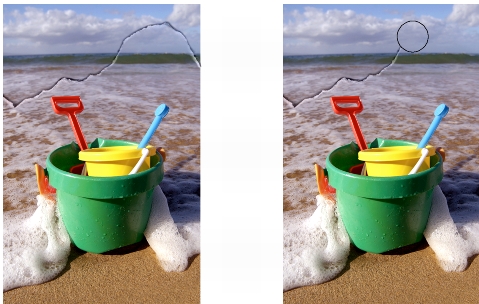
You can remove imperfections from an image by blending textures and colors with the Touch-up brush tool.
|
You can use the Touch-up brush tool on images in the grayscale, duotone,
Lab, RGB, and CMYK color modes.
|
 |
You can quickly choose a square or round brush shape by clicking the Round
nib button  or the Square nib button or the Square nib button  on the property bar. on the property bar.
|

|
Copyright 2010 Corel Corporation. All rights reserved.